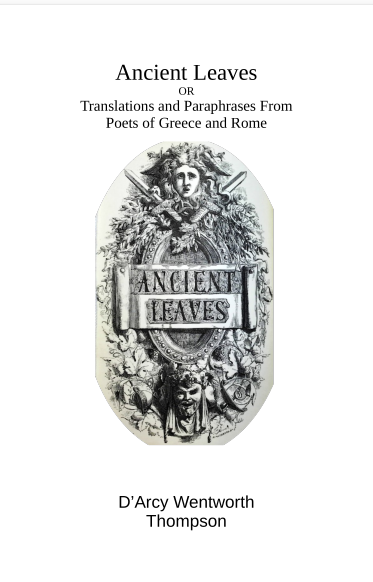
When I began the process of transcribing these books, I never imagined how much I would enjoy the work. Reading these texts as I transcribe them makes the entire project feel effortless and leisurely. Thompson's Ancient Leaves, or Translations and Paraphrases from Poets of Greece and Rome is an anthology of classical works translated during the Victorian era.
D'Arcy Wentworth Thompson—also known as D'Arcy Thompson the Elder to differentiate him from his famous biologist son—was a classical master at the Edinburgh Academy and Professor of Greek at Queen's College, Galway. These translations make up his first published book, originally printed in 1862 by Edmonston and Douglas.
Tragedy and the Trojan War
The book begins with two ancient tragedies, Ajax and Iphigenia in Aulis, followed by two excerpts from Homer's Iliad. Ajax, a play by Sophocles, is the longest work in the collection, making up about a quarter of the material.
Comparing Greek tragedies to more recent works like Shakespeare highlights a few notable differences—at least in my opinion (my classical training might make me biased)—that really enhance the experience:
- Structure. Ajax has the equivalent of two acts compared to five acts in Shakespearean plays.
- Emotional depth. Most of the play is discourse, capturing every single character's raw emotions.
- Choral movement. Greek tragedies feature choral odes divided into a strophe, antistrophe, and epode. Ancient Greek performers moved in one direction while speaking the strophe, turned and moved the opposite way for the antistrophe, and finished in the center with the epode—giving the performance a distinct rhythm and pace.
The most memorable moment for me is Ajax's soliloquy before his demise. He explores the same themes as Hamlet's famous "To be, or not to be" speech, yet Ajax's words (though spoken in madness) contain such romantic, vivid language that it makes Shakespeare—no offense—look like an amateur. He also arrives at a very different conclusion than Hamlet.
The next play, Iphigenia in Aulis, has only one scene. It is entirely discourse, yet it tugs on every emotional heartstring. Because these first four translations all take place during the Trojan War, they share a recurring villain: Agamemnon, King of Mycenae. I already felt he was a total *sshat in the first play, and he proves here that he can indeed sink lower. Between the plays and the Iliad, I struggle to find a character more loathsome.
Myth and Victorian Verse
From the Trojan War, Thompson moves on to excerpts from Ovid's Metamorphoses, which weaves Greek and Roman mythology into a single continuous story from the birth of the universe down to the life of Julius Caesar. He begins with the Greek hero Perseus transforming Atlas into the mountain range bearing his name. It is a mighty feat considering Perseus is the ancestor of Heracles, whose eleventh labor had him holding up the heavens after being tricked by Atlas. What stood out to me while reading this passage is knowing we can pinpoint the exact source of this specific origin myth to Ovid himself.
Next come three excerpts from the story of Ceres and Proserpine. These short passages showcase a myriad of poetic devices that highlight the versatility of classical verse, and Thompson proves his skill by rendering the myth in charming Victorian style.
Finally, the anthology closes with short poetic works from several writers of antiquity, including Simonides of Ceos, Publius Papinius Statius, Claudius Claudianus, and Gaius Valerius Catullus (not Catullus 16—get your mind out of the gutter!).
Add this freshly transcribed edition to your collection and experience these classical masterpieces through a charming Victorian lens.